
Broken shoulder treatment depends on fracture severity, patient age, and activity goals. Options range from conservative care with immobilization and physical therapy to surgical fixation using plates, screws, or pins. At Alaska Shoulder & Orthopaedic Institute in Anchorage, Dr. Kevin Paisley evaluates each fracture individually to determine the safest path to restore function and reduce pain. For additional details, review the wp.
Initial Assessment and Fracture Classification
Accurate diagnosis is the foundation of effective treatment. A shoulder fracture is a break in the bone of the shoulder joint, most commonly involving the proximal humerus. Physicians use X-rays, CT scans, and sometimes MRI to classify the fracture pattern and assess associated soft tissue damage. This classification directly dictates whether the bone can heal on its own or requires surgical intervention. For additional details, review the .
For non-displaced fractures, where the bone fragments remain aligned, conservative management is often the first line of defense. The goal is to allow the bone to heal while preventing stiffness. Patients typically wear a sling for several weeks to immobilize the joint. Dr. Paisley emphasizes that early, gentle movement is often introduced to prevent frozen shoulder, a condition where the joint capsule tightens and limits motion. For additional details, review the Customer Experience.
Conservative Care and Rehabilitation
Conservative treatment is the standard for stable, non-displaced fractures. This approach avoids the risks of surgery and focuses on natural healing. The primary components are immobilization, pain management, and structured physical therapy. Physical therapy is critical for rebuilding range of motion and strength after the bone has healed. For additional details, review the Frequently Asked Questions.
According to Harvard Health, icing the affected shoulder and performing specific strengthening exercises are key to managing soreness and rebuilding range of motion. At Alaska Shoulder & Orthopaedic Institute, rehabilitation is tailored to the patient's specific fracture pattern. For patients who are not surgical candidates, the practice also offers regenerative therapies such as platelet-rich plasma (PRP) and stem-cell-based injections to support healing, though these are used as adjuncts, not replacements for standard care.
Surgical Intervention for Displaced Fractures
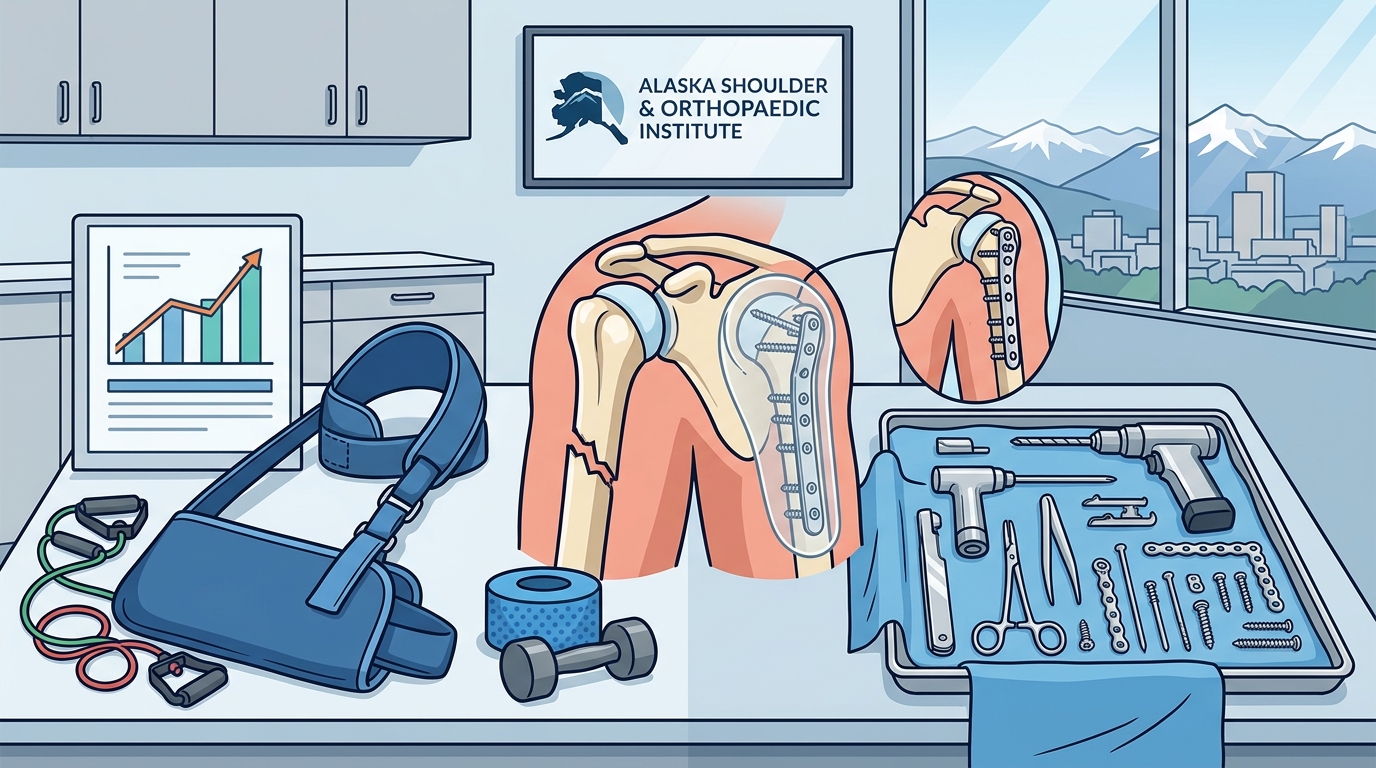
Surgery is required when bone fragments are displaced, meaning they have shifted out of alignment. If left untreated, displaced fractures can lead to malunion, where the bone heals in a wrong position, causing long-term pain and limited function. Surgical fixation involves using hardware such as plates, screws, or intramedullary nails to hold the bone fragments in the correct position while they heal.
Arthroscopic surgery is increasingly used for certain shoulder fractures, allowing for smaller incisions and potentially faster recovery. For complex fractures involving the joint surface, open reduction internal fixation (ORIF) is the standard of care. Dr. Paisley performs advanced arthroscopic and reconstructive procedures designed to restore the anatomy of the shoulder. The decision to operate is based on the degree of displacement, the patient's age, and their functional demands. according to Arthroscopic shoulder surgery
Regenerative and Biologic Therapies
It is important to note that these biologic treatments are often used off-label and are not FDA-approved for every orthopedic indication. Their use is determined on a case-by-case basis after a thorough evaluation. For patients with non-displaced fractures who are slow to heal, these therapies may provide an additional boost to the natural healing process. The practice focuses on evidence-based application of these newer modalities.
Recovery Timeline and Long-Term Outcomes
Recovery from a broken shoulder is a gradual process that varies significantly by patient. Most patients can expect to be in a sling for 4 to 6 weeks, followed by a structured physical therapy program that lasts several months. Full recovery, defined as a return to pre-injury activity levels, can take 6 to 12 months or longer. Patience and adherence to the rehabilitation protocol are essential for optimal outcomes.
Long-term outcomes depend on the initial severity of the fracture and the quality of the rehabilitation. Patients who follow their treatment plan closely generally achieve good functional results. At Alaska Shoulder & Orthopaedic Institute, the goal is to help patients return to work, recreation, and everyday activities with minimal pain. Dr. Paisley provides individualized treatment plans that consider both nonsurgical and surgical options to achieve this goal.
Key Takeaways
- Fracture classification via imaging is the first step in determining treatment.
- Non-displaced fractures are typically treated with immobilization and physical therapy.
- Displaced fractures usually require surgical fixation with plates or screws.
- Regenerative therapies like PRP and stem cells may be used as adjuncts in select cases.
- Recovery is a long process, often taking 6 to 12 months for full function.
- Individualized care is critical, as treatment depends on age, activity level, and fracture pattern.
Frequently Asked Questions
How long does it take to heal a broken shoulder?
Healing time varies, but bone typically takes 6 to 8 weeks to heal. Full recovery, including regaining strength and range of motion, can take 6 to 12 months.
Do all broken shoulders require surgery?
No. Non-displaced fractures are often treated conservatively with a sling and physical therapy. Surgery is reserved for displaced or complex fractures.
What is the role of physical therapy in shoulder fracture recovery?
Physical therapy is essential for restoring range of motion and strength after the bone has healed. It helps prevent stiffness and muscle atrophy.
Can regenerative therapies help with a broken shoulder?
When should I see a doctor for shoulder pain after an injury?
You should see a doctor immediately if you experience severe pain, swelling, deformity, or inability to move your arm after an injury. These are signs of a possible fracture.
Conclusion
Choosing the right treatment for a broken shoulder requires a detailed evaluation of the fracture pattern and your personal goals. At Alaska Shoulder & Orthopaedic Institute, Dr. Kevin Paisley provides expert care for shoulder fractures, offering both conservative and surgical solutions. To discuss your options, to schedule a consultation.